
Why Some Homes Feel Instantly Calm (and Others Don’t)
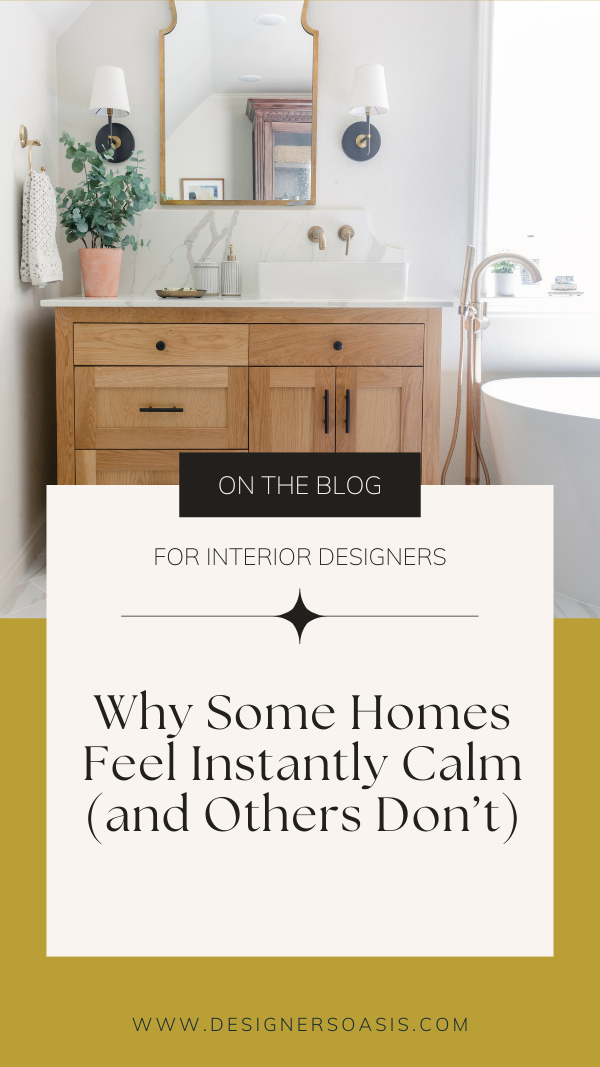
There’s a noticeable difference between spaces that feel calm and those that don’t.
It’s something most people can sense immediately, even if they can’t explain why.
You walk into one space, and everything feels settled. Your body relaxes without effort. You don’t feel rushed or overstimulated. The environment feels supportive in a way that’s quiet but very real.
Then you walk into another space, and something feels slightly off.
Not necessarily wrong. Not poorly designed. But there’s a subtle tension. Your attention moves quickly from one element to another. It’s harder to settle in.
This difference isn’t just about personal taste.
It’s about how the space is working as a whole.
Calm Is Created Through Alignment, Not Simplicity Alone
There’s a common assumption that calm spaces are simply minimal.
Less color. Fewer objects. Clean lines.
And while simplicity can play a role, it’s not the defining factor.
A space can be minimal and still feel cold or disconnected.
What actually creates calm is alignment.
When elements within a space feel cohesive—when they relate to each other in a way that makes sense visually and spatially—the brain processes the environment more easily.
That ease translates into a feeling of calm.
Your Brain Is Processing More Than You Think
When someone enters a space, their brain immediately begins organizing what it sees.
It’s identifying patterns, evaluating contrast, and trying to understand how the space functions.
If there are too many competing elements—conflicting materials, inconsistent scale, or unclear focal points—the brain has to work harder to process it.
That effort creates subtle tension.
Even if the person isn’t consciously aware of it.
On the other hand, when a space is well balanced, the brain doesn’t have to work as hard.
There’s a natural flow to how the eye moves. A sense of predictability in how elements relate.
And that creates a feeling of ease.
The Role of Visual Noise
Visual noise is one of the most common reasons a space doesn’t feel calm.
This doesn’t necessarily mean clutter in the traditional sense.
It can show up as:
too many competing focal points
inconsistent color direction
layering that lacks intention
too much variation in scale or texture
Individually, each element might be beautiful.
But when they’re combined without a clear hierarchy, the result feels scattered.
The eye doesn’t know where to land.
And when the eye doesn’t settle, the body doesn’t either.
Movement Through a Space Matters Just as Much as What’s In It
Calm isn’t just visual.
It’s spatial.
How someone moves through a space plays a significant role in how that space feels.
If pathways are unclear or interrupted, it creates friction.
If furniture placement doesn’t support natural movement, it creates subtle resistance.
These things aren’t always obvious, but they’re felt.
When movement is intuitive, the space feels supportive.
When it’s not, the space feels slightly unsettled.
Why This Matters for Your Clients
Most clients won’t walk into a space and say, “This lacks visual hierarchy” or “The layout is creating friction.”
They’ll say things like:
“Something feels off”
“I don’t know why I don’t love it”
“It doesn’t feel as good as I expected”
They’re describing an emotional experience without having the language for it.
This is where your role becomes more important.
You’re not just selecting pieces.
You’re shaping how someone experiences their home.
Designing for Emotional Response
When you begin designing with emotional response in mind, your approach shifts.
You’re not just asking:
“What looks good here?”
You’re asking:
“How will this feel when someone walks in?”
“How will they move through this space?”
“What will their experience be over time?”
This adds a layer of intention that goes beyond aesthetics.
Practical Ways to Create Calm in Your Designs
Creating calm doesn’t require a complete reinvention of your process.
It requires refinement.
You can begin by:
reducing unnecessary variation in materials and finishes
establishing clear focal points within each space
creating consistency in scale and proportion
ensuring layout supports natural movement
simplifying where possible without removing personality
These changes don’t make a space less interesting.
They make it more cohesive.
The spaces that feel the best aren’t always the most elaborate.
They’re the ones where everything works together.
Where the brain doesn’t have to work to understand what it’s seeing.
Where the body can settle without effort.
That’s what calm actually is.
And when you design with that in mind, your work begins to feel different—not just to you, but to the people living in it.
Related Links:
Join me for The Science of Beautiful Spaces Masterclass with Daniel House Club
Learn more about including this process in your interior design work inside the Design Process Masterclass