
Neuroaesthetics and Interior Design: The Science Behind Beautiful, Intentional Spaces
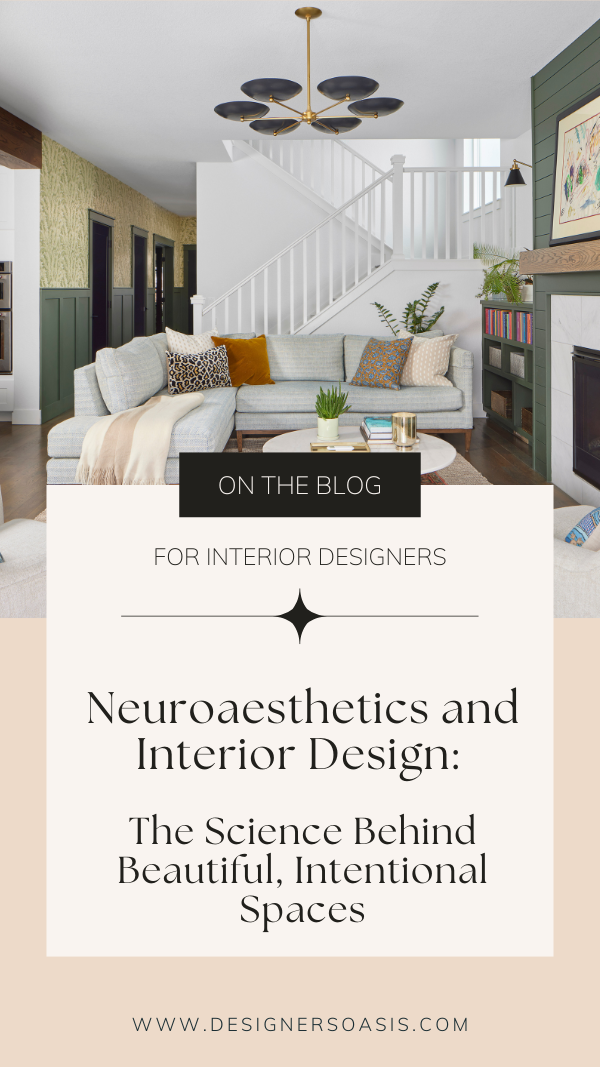
If you've ever walked into a space and felt an immediate sense of calm—or the opposite, a subtle but persistent unease—you've experienced neuroaesthetics at work.
As interior designers, we create environments that shape how people feel, think, and function every single day.
But most of us were never taught why that happens.
That's exactly what neuroaesthetics offers: the science behind the feeling.
In this post, we're diving deep into neuroaesthetics and what it means for your interior design practice—because understanding the why behind beautiful spaces doesn't just make you a better designer. It makes you indispensable to your clients.
What Is Neuroaesthetics?
Neuroaesthetics is the scientific study of how the brain responds to aesthetic experiences—including the spaces we inhabit. It sits at the intersection of neuroscience, psychology, and design, drawing on decades of research into how our nervous systems process beauty, pattern, light, and form.
In practical terms, it helps us understand why some spaces feel instantly right while others feel subtly wrong—even when both might look beautiful in a photograph. The difference often comes down to how the brain processes what the body is experiencing in that environment.
For interior designers, this is transformative knowledge. It means your design decisions aren't just aesthetic preferences—they're informed choices with measurable impact on the people who live and work in the spaces you create.
The 3 Core Principles of Neuroaesthetics in Design
Research in this field has identified three primary qualities that the brain seeks in aesthetically pleasing environments. Understanding these can fundamentally change how you approach every project.
1. Coherence
Coherence refers to the sense of order, balance, and predictability in a space. Our brains are pattern-seeking organs—we are constantly scanning our environment for cues that tell us whether we are safe, and coherent environments signal safety.
A coherent space doesn't mean a boring one. It means the space has an underlying logic: a consistent material palette, a clear visual hierarchy, proportions that feel intentional. When coherence is present, people feel relaxed without knowing why. When it's absent—even in a stylistically "interesting" space—people often feel vaguely unsettled.
In practice: Develop a tight material and color story for every project before you buy a single item. Three to five materials that speak to each other creates coherence. Twenty materials that each "go together" often doesn't.
2. Fascination
If coherence is the foundation, fascination is what keeps people engaged. The brain is also novelty-seeking—it needs stimulation, discovery, and visual interest to stay alert and curious.
Fascination in design comes from layering: texture on texture, the interplay of light and shadow, a surprising accent, a piece of art that draws the eye. It's the quality that makes a space feel alive rather than flat—the thing that makes someone want to look more closely.
In practice: Design one focal point per room that creates a moment of discovery. It could be a bold wallpaper, a sculptural light fixture, or an unexpected material combination. Give the eye somewhere to go.
3. Hominess
Hominess is the quality that makes a space feel personally meaningful—warm, familiar, safe, and ours. Research shows this is one of the most powerful emotional responses a space can evoke, and it's deeply tied to how much a person can see themselves in the space.
This is why personalization matters so much. A technically flawless interior that doesn't reflect the people who live there will often feel like a hotel—beautiful but not quite right. Hominess is created through the accumulation of personal objects, soft textures, warm light, and design choices that honor the client's story.
In practice: Reserve space in every design for the client's personal items. Ask about the objects that matter to them and find ways to honor them in the design. A space that feels like them will always feel better than a space that looks like a magazine.
The Role of Biophilic Design
Biophilic design is one of the most powerful applications of neuroaesthetic principles—and one of the most in-demand trends in interior design right now. Biophilia refers to the innate human affinity for nature, and biophilic design uses that affinity to create spaces that support health, wellbeing, and cognitive function.
Research has shown that exposure to natural elements—light, plants, water features, organic textures, natural materials—reduces cortisol levels, lowers blood pressure, improves focus, and accelerates recovery from stress. These aren't soft benefits. They're measurable physiological changes.
For your clients, this means the decision to incorporate real wood, natural stone, living plants, or views of the outdoors isn't just an aesthetic choice. It's a wellness decision. And when you can articulate it that way, you move from decorator to trusted advisor.
Biophilic design elements to incorporate:
Natural light optimization (maximize windows, use mirrors strategically)
Organic textures: linen, jute, raw wood, stone, rattan
Living walls or potted plants
Water features in commercial or high-end residential projects
Nature-inspired patterns in textiles or wallcoverings
Color palettes drawn from natural environments
Why This Changes Your Practice
Understanding neuroaesthetics doesn't just make you a more intentional designer—it changes how you communicate with clients.
Instead of saying "I think this wallpaper will really make the room feel special," you can say "This wallpaper creates visual fascination, which is one of the brain's key criteria for a space that feels alive and engaging." That's not the same conversation.
It also helps you hold your ground on design decisions. When a client wants to add one more thing to a space that's already visually complete, you can explain why coherence matters—and why more isn't always better. When they're skeptical about a plant wall, you can share the research.
You become the expert. Not just the person with good taste, but the person who understands why something works.
Applying Neuroaesthetics to Every Project
Here's a simple framework to apply these principles in your process:
In the programming phase: Ask clients about spaces that have made them feel particularly calm, energized, or at home. Ask what emotions they want to feel in this new space. Use this to guide your coherence and hominess decisions.
In the concept phase: Build your material and color story with coherence as the foundation. Then add one or two elements of fascination—the unexpected, the textured, the layered.
In the specification phase: Prioritize natural materials wherever budget allows. They don't just look beautiful; they perform better neurologically.
In the presentation phase: Use neuroaesthetic language. Tell clients how the space will make them feel and why. This is one of the most powerful tools you have for getting design decisions approved.
The Bigger Picture
Design is not neutral. Every choice you make in a space—the light temperature, the floor material, the ceiling height, the view from the sofa—shapes how the people in that space will feel. And now that you understand the science behind it, you can make those choices with intention.
Neuroaesthetics isn't a trend. It's the underlying reason design has always mattered, finally given a language and a framework. And as a designer who understands it, you're not just creating beautiful rooms. You're creating spaces that genuinely improve people's lives.
That's a very different kind of work. And it's exactly the kind of designer the world needs more of.
Related Links:
Check out my curated collection with Daniel House Club
Learn more inside the Science in Design course with Mike Peterson - use code kate100 for $100 off!